
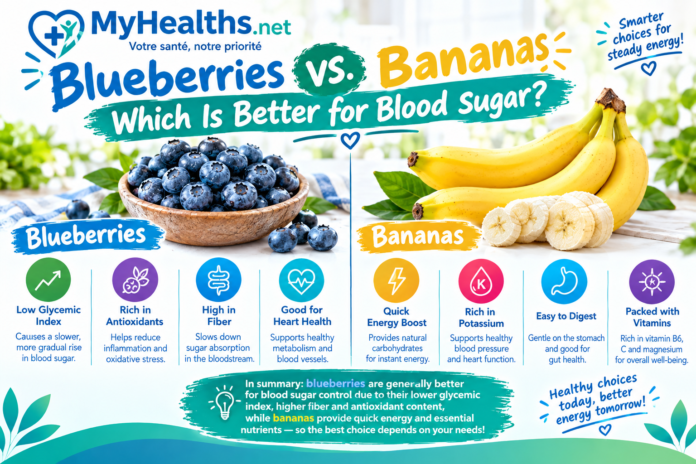
Blueberries vs. Bananas: Which Is Better for Blood Sugar?
When it comes to fruit and blood sugar, people with diabetes or prediabetes often wonder whether some fruits are better choices than others. Two popular options—blueberries and bananas—are both nutritious, but they affect blood glucose differently.
So, which is better for blood sugar?
For most people trying to keep post-meal blood glucose more stable, blueberries have an advantage, particularly because they are relatively low in carbohydrate per typical serving and provide fiber and polyphenols. However, bananas are not a “bad” fruit for people with diabetes. Portion size, ripeness, what you eat with the fruit, and your own glucose response all matter. diabetes
The most important point is that there is no need to eliminate fruit simply because it contains natural sugar. Whole fruit can absolutely be part of a balanced diabetes-friendly diet. diabetes.
Blueberries vs. Bananas at a Glance.
| Blueberries | Bananas | |
|---|---|---|
| Blood sugar impact | Generally lower per serving | Moderate, depending on portion and ripeness |
| Fiber | Good source | Good source |
| Glycemic index | Generally low | Low to moderate; varies |
| Main advantage | Lower-carb option with polyphenols | Potassium, carbohydrates and convenient energy |
| Best use | Snacks, yogurt, oatmeal, salads | Pre-workout snack, breakfast, smoothies |
| Diabetes-friendly? | Yes | Yes, in an appropriate portion |
The American Diabetes Association lists both blueberries and bananas among fruits that can fit into a diabetes meal plan. diabetes
What Is the Glycemic Index?
The glycemic index (GI) measures how quickly a carbohydrate-containing food raises blood glucose compared with a reference food.
A low-GI food generally produces a slower, more gradual rise, while a high-GI food can produce a faster rise. But GI is not the whole story.
Another useful concept is glycemic load (GL), which takes both the food’s GI and the amount of carbohydrate eaten into account. This is important because a food with a relatively low GI can still raise blood sugar significantly when eaten in a large portion.
For people with diabetes, portion size and total carbohydrate intake are often more practical considerations than GI alone. The CDC notes that there is no single carbohydrate amount that works for everyone; individual needs depend on factors such as activity, medications, and other health considerations. CDC.gov

